










5 Charlie Munger Investing Lessons Every Value Investor Should Live By
 Phil Town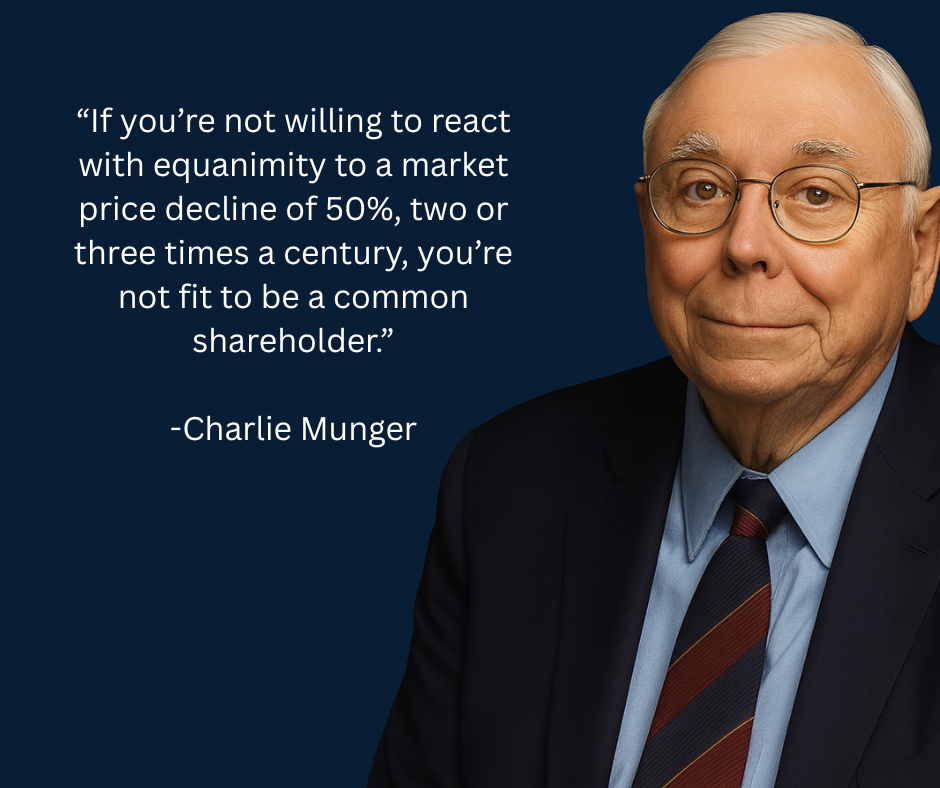
If you know me, you know Charlie Munger has been one of my greatest investing idols. I've got his bust sitting right on my desk. The man was 99 years old when he passed, with a net worth of around $2.7 billion, not because he chased risk, but because he mastered the fundamentals and stayed rational when most people lost their minds.
Now, Charlie was often known as Warren Buffett's right-hand man, but I'd argue he was a titan in his own right. What most people don't realize is that his principles aren't just wisdom to admire. They're a system you can actually use.
I've spent years teaching the Rule #1 framework to everyday investors. People who thought investing was too complicated, too risky, or just not for them. And the more I teach it, the more I see how much of what Charlie Munger believed maps directly to what Rule #1 investors do every single day. Same principles. Same discipline. Same results when you stick with it.
Charlie Munger's investment philosophy was built on a simple idea: draw from multiple disciplines to make better decisions. He called this a latticework of mental models. Rule #1 is exactly that kind of framework.
So today, I'm walking you through five Charlie Munger investing lessons and showing you exactly how to put them to work.
https://www.youtube.com/embed/w-i2u1bNyPc?si=HZVd8ouvpdakpJW9
1. Inversion: Think Backwards to Make Smarter Decisions
One of the first lessons I learned from Charlie was the power of inversion. Most people ask, "How can I succeed?" Charlie asked, "How can I fail?" and then worked backward to avoid that outcome.
He explained this beautifully in a story about his time as a weather forecaster for pilots. Instead of asking how to do the job well, he asked himself, "How could I get these pilots killed?" A dark question, but it led him to identify the two biggest threats: icing and fuel exhaustion. Avoiding those meant keeping people alive. Simple. Rational. Effective.
That is the exact mindset I take into Rule #1 Investing. Instead of starting with "How do I make a killing in the market?" I ask, "How could I lose everything?" and then I build systems to avoid those mistakes. It is why Buffett's two famous rules are:
Don't lose money.
Never forget rule #1.
If you obsess over not screwing up, the wins will take care of themselves.
How I Use Inversion Every Time I Look at a Business
I use the same thinking every single time I look at a business. Before I buy anything, I ask what would have to go wrong for me to lose money. That question changes everything.
It is the same question behind every step of the Four M's:
Does this business have a durable competitive advantage, or is there something that could knock it out in the next ten years?
Is management honest and working for shareholders, or quietly working against them?
Is the price low enough that even if I get something wrong, I still do not lose?
That last question is what the Margin of Safety is built for. You buy at a big enough discount to what a business is actually worth so that a mistake does not wipe you out.
2. Stay Calm: Why Great Investors Don't Panic
Charlie was a master of temperament. He didn't flinch when the markets dropped. And trust me, they dropped hard. Berkshire Hathaway stock declined by 50% three times during his tenure. Did he panic? Not even a little.
He once said:
"If you're not willing to react with equanimity to a market price decline of 50%, two or three times a century, you're not fit to be a common shareholder."
Let that sink in.
That level of calm is what separates great investors from average ones. Most people panic during market dips. They lose sleep, question their decisions, and often sell at the worst time. But those drops? I welcome them. They are when I find companies on sale.
Calm Is Not a Personality Trait. It Is a Skill You Build.
Most people hear that Munger quote and think he was just built differently. That he had some rare gift that let him watch his portfolio get cut in half and feel nothing. That is not what was happening.
Munger was calm because he knew exactly what his businesses were worth. When you know that, a falling stock price stops being scary. It becomes useful information. Sometimes it becomes an opportunity.
Think about it this way. If you walked past a store and saw a jacket you loved marked down 30%, you would not panic. You would buy it. Investing works the same way, but only if you already know what the business is worth before the price drops.
Here is how Rule #1 investors build that kind of calm:
Learn what a business is actually worth using the Big Five Numbers. These confirm whether the moat is intact and the business is still healthy.
Set your Margin of Safety price, the discounted price at which the business becomes a great deal.
Wait. When Mr. Market gets emotional and drops the price to your number, you are ready.
You are not guessing. You are not panicking. You are buying.
This philosophy is rooted in Kipling's poem If, which Charlie loved. "Treat those two impostors just the same," it says, referring to success and failure. I don't celebrate bull markets or cry in bear markets. I prepare for both. I train myself to stay emotionally even. Because volatility isn't my enemy. It's my edge.
"The big money is not in the buying or the selling, but in the waiting." — Charlie Munger
[r1-cta-banner handle=“investors-survival-guide”]
3. Humility: Know What You Don't Know
Charlie wasn't polite in the traditional sense. He once refused to take a picture with me after I published a New York Times bestselling book. But he was humble in the deepest sense. He knew exactly where his knowledge ended and refused to go past that line.
He called it knowing your circle of competence, and it's one of the most important rules in investing.
Warren Buffett once said, "I'd rather deal with a guy with an IQ of 130 who thinks it's 125 than a guy with an IQ of 180 who thinks it's 200. That second guy will kill you."
Being honest about what you don't know is a competitive advantage. It keeps you from making bets on things you don't understand. It keeps you safe.
When I teach Rule #1 Investing, I emphasize this constantly: if you don't understand the business, you don't buy it. Period. You don't guess. You don't gamble. You wait until it's clear.
That's humility in action. It is some of the most valuable Charlie Munger investment advice any investor can follow.
4. Your Circle of Competence Is Your Competitive Advantage
Here's a scenario. Let's say you buy a stock based on a hot tip. The next day, it drops 20%. What do you do? Do you buy more? Do you panic and sell?
The truth is, if you don't fully understand that business, you won't have the foggiest idea what to do. And that is exactly the kind of confusion Rule #1 investors avoid.
Charlie made it crystal clear: only invest in businesses you understand deeply. Stay in your circle of competence. When you do, you'll be able to make rational decisions no matter what the market throws at you.
That's why my ideal companies are often incredibly simple. I love businesses that are so clear and so good that, as Charlie said, "an idiot could run it." And even better if a great CEO is at the helm.
How to Find Your Investing Lane
The way I help students find their lane is a simple exercise called the Three Circles. Grab a piece of paper and draw three circles. Label them:
Passions: what you love to do, or would do if you had the time
Talents: what you are genuinely good at
Money: what you spend money on or earn money from
Look for anything that shows up in more than one circle. Those are the areas where you already have a real edge. Industries and businesses you understand better than most people without even trying.
When I did this exercise, river guiding showed up in all three of my circles. That led me to cruise lines, outdoor recreation companies, and travel businesses. I could walk into those industries with real confidence because I had lived inside them. You have areas like that too. You just have not connected them to investing yet.
Start there. The Four M's evaluation begins with Meaning. And Meaning begins with knowing your lane.
In 1999, Berkshire stayed out of tech stocks entirely during the dot-com boom. When the bubble burst in 2000, Berkshire emerged unscathed. That is circle of competence in action. Not a limitation. A competitive advantage.
5. Great Businesses: Buy Companies That Thrive Without Perfection
Charlie had a line I'll never forget: "I want to buy something that an idiot could run and then I want a wonderful person to run it."
The truth is, the best businesses don't rely on perfection. They have systems, pricing power, loyal customers, and wide economic moats. They can survive a bad quarter or even bad leadership for a while. That's what I look for in Rule #1 investing.
Warren once said he'd choose a great business over a great person. And that's because a great business has built-in durability. A bad business, on the other hand, can collapse from a single mistake.
What Makes a Business Great: The Moat
The first idea in Munger's line is about the business itself. It has to be strong enough to survive imperfection. That strength has a name: a moat.
Charlie described Coca-Cola as the perfect business. Even if you had a billion dollars and tried to compete with Coke, you could not do it. The brand is too strong. The distribution is too deep. The habit is too ingrained. People do not go for a soda. They go for a Coke.
A moat is a durable competitive advantage that protects a business from attack. In Rule #1 it is the second M.
There are five types:
Brand: People pay more because they trust it. Think Coke, Apple, Harley-Davidson.
Secret: A patent or trade secret competitors cannot copy. Think Pfizer.
Toll: Exclusive control of a market. Think utilities.
Switching: Customers are locked in because leaving is too painful. Think Microsoft.
Price: Costs so low that no one can compete. Think Walmart.
You can go deeper on all five at How to Spot a Competitive Moat. And once you have identified the moat, the Big Five Numbers are how you confirm it is real and holding up over time.
As Buffett famously said, a lesson Munger helped teach him: 'It's far better to buy a wonderful company at a fair price than a fair company at a wonderful price.' That shift in thinking changed Berkshire forever.
The Other Half: Management
The second idea in Munger's line is about the people running the business. A great moat buys you resilience. Great management builds on top of it.
In Rule #1, this is the third M. I look for leaders who think like owners, act in decades not quarters, and tell shareholders the truth even when the news is bad.
Munger also believed that good businesses are ethical businesses. Management that cuts corners or misleads shareholders eventually destroys the moat. Integrity is not just a character trait. It is a business fundamental.
I look for management whose incentives are aligned with shareholders. When leaders own significant stakes in the business and are compensated based on long-term performance, they think like owners. That is exactly what I want.
When I look for companies to invest in, I look for this exact strength: resilience. Simplicity. Repeatable cash flow. And most importantly, a margin of safety.
Final Thoughts: Munger's Legacy and Rule #1 Application
Charlie Munger didn't build his wealth by being flashy or chasing trends. He did it by being rational, humble, calm, and precise. He avoided mistakes. He stayed within his circle. He bought wonderful companies at fair prices and he held on.
That's what I teach at Rule #1. That's how I invest. That's how you can invest, too. If you are just getting started, the investing for beginners guide is a good first step.
As Munger put it: "All intelligent investing is value investing, acquiring more than you are paying for." That is Rule #1 in one sentence.
If you want to dive deeper into these strategies, come to my next Rule #1 Investing Workshop. I'd love to walk you through everything, from understanding a business to calculating its value to building your confidence as a long-term investor.
We've helped over 25,000 people learn this stuff, and I've got the NPS scores to back it up, higher than Harvard's MBA program. This workshop could be the best decision you ever make for your financial future.
[r1-cta-banner handle=“virtual-investing-workshop”]

Phil Town
Phil Town is an investment advisor, hedge fund manager, 3x NY Times Best-Selling Author, ex-Grand Canyon river guide, and former Lieutenant in the US Army Special Forces.